
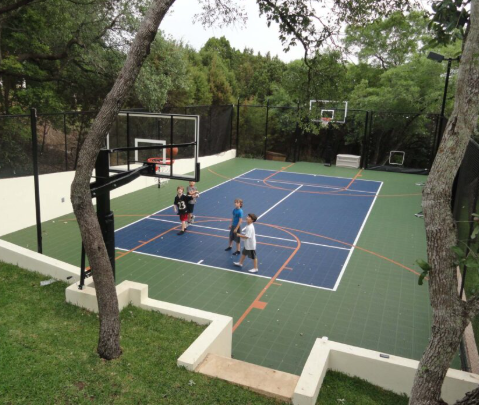
A driveway or slab is fine for parking. But for basketball, pickleball, volleyball, futsal, or multi-game play, a real sport court outperforms plain pavement on safety, performance, and long-term maintenance — and it looks better doing it.
1) Safer on Joints (Shock Absorption)
-
Built-in cushioning: Modular sport tiles and poured sport surfaces absorb impact, reducing stress on knees/ankles compared with rigid concrete or asphalt.
-
Injury reduction: Less slip-and-slide, fewer harsh falls, and more controlled stops.
2) All-Weather Traction & Faster Drying
-
Textured grip patterns keep traction consistent when dusty or slightly wet.
-
Vented tiles drain through the surface so puddles don’t end play; pavement holds water, algae, and slick spots.
3) True Ball Response (Designed for Play)
-
Predictable bounce and lateral traction designed for court sports.
-
Line integrity: Factory-straight game lines and color zones — not flaking paint on rough concrete.
4) Cooler Under Foot
-
Lower surface temps: Many sport tiles run cooler in the sun than dark asphalt, with color choices that don’t soak heat.
-
Barefoot-friendly: Great for backyard courts near pools and patios.
5) Quiet, Neighbor-Friendly
-
Noise dampening: Tile systems reduce the “smack” and echo you get on bare concrete, keeping the peace with neighbors.
6) Customizable & Multi-Sport
-
Modular layout: Add basketball keys, pickleball kitchens, volleyball boundaries — even swap nets and uprights.
-
Pro colors & logos: Team palettes, school colors, and center-court graphics elevate the space.
7) Easy Repairs & Long Life
-
Tile replacement: Pop out a damaged panel and snap in a new one; no cutting, patching, or mismatched asphalt.
-
UV-stable finishes: Resist fading and chalking far better than painted concrete.
8) Cleaner, Lower-Maintenance
-
Simple upkeep: Leaf blow, rinse, occasional mild cleaner.
-
No reseal cycles: Asphalt needs periodic sealing; concrete coatings peel; sport tiles keep performing.
9) Better Drainage & Site Flexibility
-
Water management: Perforated tiles + sloped sub-base move water off the play surface.
-
Retrofit-friendly: Install over existing slabs (after leveling) or build new over compacted base without pouring large monolithic pads.
10) Resale & Aesthetics
-
Purpose-built amenity: A finished sport court boosts curb appeal more than a painted driveway square.
-
Reversible: Many systems can be uninstalled or relocated if you remodel.
What We Build (Popular Setups)
-
Basketball + pickleball combo courts (half or full)
-
Driveway conversions with modular tile overlay and anchored hoop
-
Backyard multi-sport (hoops, volley, badminton, futsal)
-
School/church/playground courts with high-wear tiles
Our Court Process (Start to Play)
-
Site walk & layout – Measure setbacks, slopes, and access.
-
Base prep – Level, compact, and ensure drainage (or skim-coat an existing slab).
-
System selection – Tile or poured surface matched to sports, climate, and budget.
-
Install & lines – Snap tiles, lock edging, set anchors, apply pro-grade lines.
-
Accessories – Hoops, nets, rebounders, lights, windscreens.
-
Handoff – Care guide and warranty.
Cost Factors (Transparent & Predictable)
-
Size & lines (single vs. multi-sport)
-
Base work (new base vs. overlay, leveling needs)
-
Tile type (premium cushion, UV package, custom colors)
-
Accessories (pro hoop systems, lighting, fencing)
Pro tip: If you already have a decent slab, tile overlays deliver a huge upgrade without the cost of demo and re-pour.